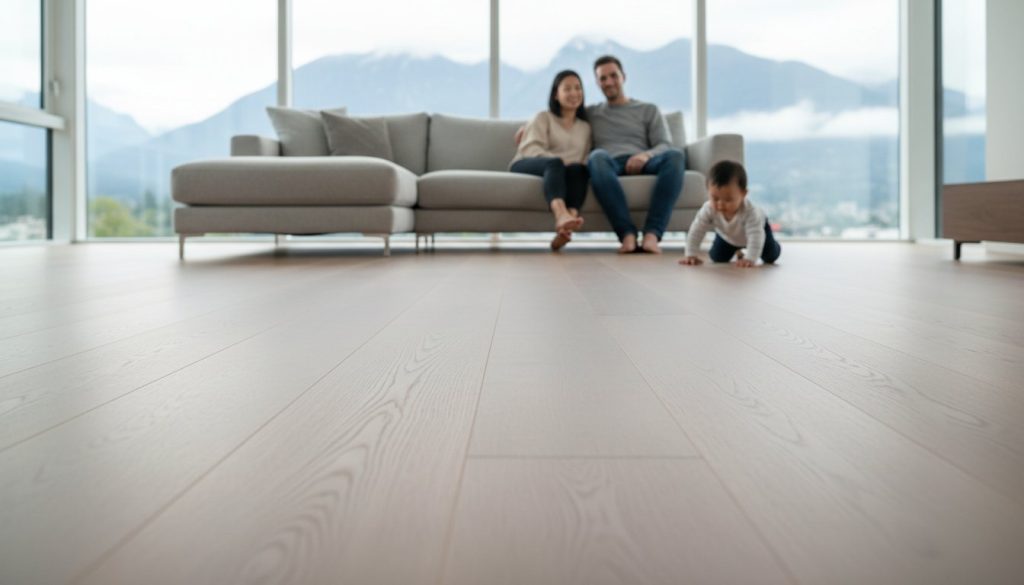
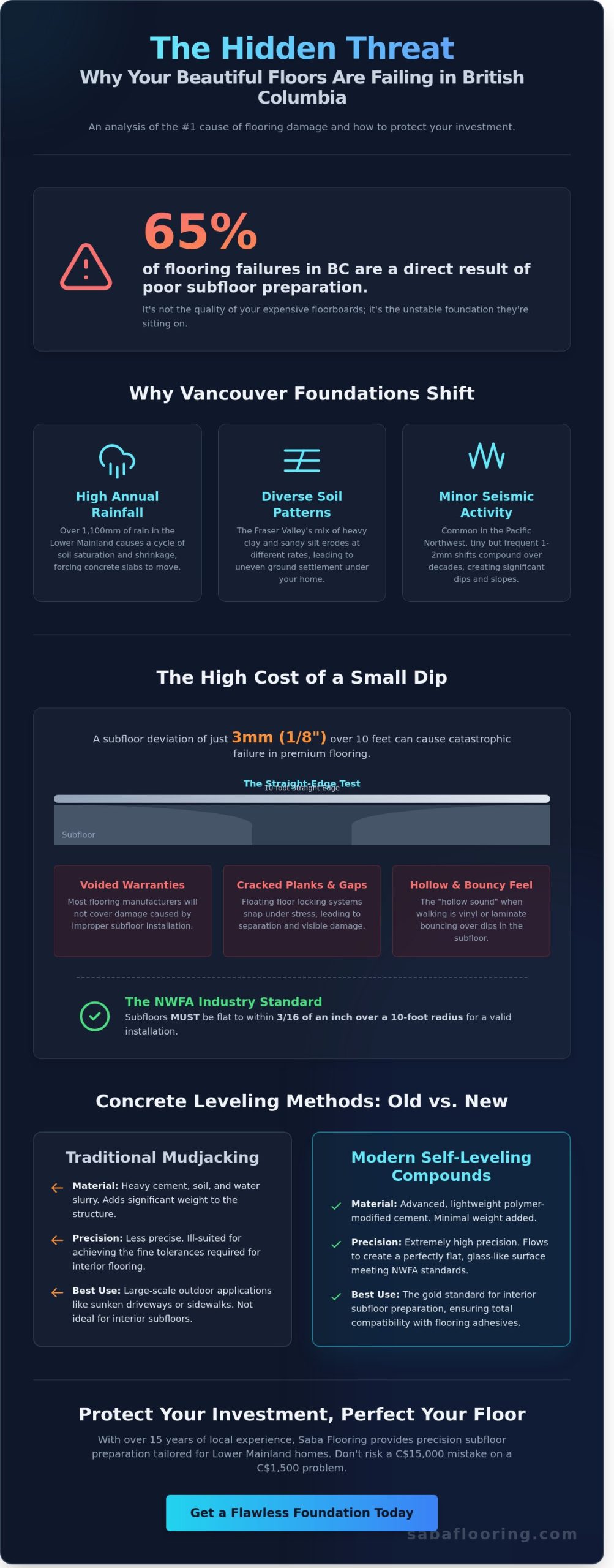
Have you ever wondered why your brand new floorboards are already creaking or why there’s a visible gap under your baseboards despite a fresh installation? It’s frustrating to invest thousands in beautiful materials only to feel a bounce under your feet every time you walk across the room. You likely believe that a premium product should handle a few minor bumps, but even a three-millimetre deviation can cause high-end planks to crack or separate over time. According to recent industry assessments, nearly 65 percent of flooring failures in British Columbia are the direct result of poor subfloor preparation.
We understand that the technical side of home renovation feels daunting. This guide explains how professional Canadian concrete leveling provides the essential foundation your Vancouver home needs to protect your investment and secure your flooring warranty. With over 15 years of experience serving the Lower Mainland, we’ve seen how a perfectly flat surface transforms a project from a stressful renovation into a lasting masterpiece. You’ll discover the critical differences between self-leveling and mudjacking, alongside the specific cost-benefit of getting your subfloor right the first time. We’re here to help you move from confusion to a flawless, stable floor that stands the test of time.
Key Takeaways
- Understand how the Lower Mainland’s unique moisture levels impact your foundation and why professional leveling is essential for long-term floor stability.
- Explore the technical shift in canadian concrete leveling from traditional mudjacking to modern compounds that ensure a flawless, lightweight subfloor.
- Learn to perform a “straight-edge test” to accurately measure floor deviations and identify when professional intervention is mandatory for your home.
- Compare the weight and durability implications of different slab-lifting methods to choose the most effective solution for your specific Vancouver renovation.
- Discover how Saba Flooring leverages 15 years of local experience to provide subfloor preparation perfectly tailored to your dream floor’s requirements.
The Reality of Canadian Concrete Leveling: Why Vancouver Foundations Shift
Vancouver’s unique geography creates a specific set of challenges for local homeowners. In the context of residential architecture here, concrete leveling is the process of restoring a flat, stable surface to a slab that has sunk or tilted over time. Whether you’re in a mid-century bungalow or a modern condo, the stability of your floor depends on the ground beneath it. For those seeking concrete leveling techniques that actually last, it’s vital to understand that canadian concrete leveling is shaped by our local environment. High annual rainfall in the Lower Mainland, which averages over 1,100mm in some areas, creates a cycle of soil saturation and shrinkage that forces concrete to move.
The “Vancouver dip” is a term our team often encounters when inspecting North Vancouver and Burnaby homes built between 1950 and 1970. With over 15 years of experience, we’ve seen how these minor shifts can compromise a home’s interior. This isn’t always a structural foundation failure; it’s often a localized settling of the interior slab. While structural foundation repair involves stabilizing the perimeter walls of a house, interior subfloor leveling focuses on creating a flawless, flat plane ready for new flooring. This distinction is critical for homeowners who want to transform their space without overspending on unnecessary deep-foundation work.
Common Causes of Uneven Concrete in BC
- Soil erosion and settlement patterns: The Fraser Valley features diverse soil patterns, from heavy clay to sandy silt, which erode at different rates during heavy rain seasons.
- Seismic activity: Minor seismic activity, common in the Pacific Northwest, can cause 1mm to 2mm shifts that compound over decades.
- Poor initial pours: Many mid-century builds in Vancouver didn’t use modern vapor barriers or reinforcement, leading to slabs that crack and settle as the ground settles.
Professional canadian concrete leveling addresses these local quirks by filling the voids left by shifting earth. We use precision methods to ensure your subfloor provides a timeless and durable base for your renovation project.
The Cost of Ignoring an Uneven Subfloor
Ignoring a slope might seem harmless, but it’s a financial risk. A deviation of just 1/8-inch can cause the locking mechanisms of a C$15,000 hardwood or laminate floor to snap within 24 months. This leads to the “hollow sound” often heard in vinyl plank installations, where the material bounces against a dip in the subfloor. According to National Wood Flooring Association (NWFA) standards, a subfloor must be flat to within 3/16 of an inch over a 10-foot radius to ensure a durable installation. Don’t let a minor dip ruin your investment; addressing the subfloor first ensures your dream floors are just one step away from perfection.
Methods of Professional Floor Levelling and Surface Preparation
Vancouver’s unique geography often leads to subtle foundation shifts that compromise interior surfaces. While older techniques relied on mudjacking, modern canadian concrete leveling has evolved into a high-precision science. Our technical toolkit now prioritizes advanced polymers and mechanical refinement over bulky cement fillers. Surface preparation is the most critical billable hour in any flooring contract. It’s the foundation of the entire project. If the subfloor isn’t perfectly stable, even the most expensive hardwood will fail within 24 months. Statistics show that 90% of flooring failures result from poor subfloor preparation rather than the material itself. We focus on ensuring total compatibility between the levelling agent and the final adhesive to prevent delamination. This meticulous approach is how we transform your living space into a durable masterpiece.
Issues often start deep underground where homeowners cannot see them. A 2024 report by the Senate of Canada on Canadian soil degradation highlights how shifting soil health impacts structural stability across the country. In the Lower Mainland, this movement creates the uneven “waves” you feel under your current carpet or laminate. Addressing these imperfections requires a blend of technical authority and local experience.
Self-Levelling Compounds (SLC): The Interior Gold Standard
Self-levelling compounds use high-flow polymers to create a glass-flat surface that traditional concrete cannot match. These mixtures are engineered to find the lowest point of a room and settle into a perfectly horizontal plane. It isn’t just about pouring the liquid; it’s about the chemistry of the bond. We always prime the existing concrete first to prevent moisture wicking, which can cause the compound to crack. In the humid Vancouver climate, drying times are vital. While some products claim to be ready in 4 hours, our 15 years of experience shows that 24 to 48 hours is often necessary for a flawless bond when humidity levels exceed 70%.
Concrete Grinding vs. Filling
Professional installers must decide whether to take the “high spots” down or fill the “low spots” up. Grinding is often the superior choice for stubborn high points caused by slab curling or old adhesive residue. We use industrial diamond-tipped grinders to shave away imperfections with millimetre precision. For occupied residences in Burnaby or North Vancouver, we employ HEPA-filtered dust containment systems to ensure your indoor air remains clean. From grinding down ridges to filling deep divots, we use a problem-solution framework to determine the most cost-effective path for your specific renovation. This ensures your subfloor is ready for any material, from porcelain tile to luxury vinyl plank.
Comparing Concrete Raising: Mudjacking vs. Modern Poly-Leveling
Homeowners in the Lower Mainland often face the frustration of sinking walkways or uneven garage floors. To address these issues, two primary methods dominate the canadian concrete leveling industry: traditional mudjacking and modern polyurethane injection. While both aim to restore a level surface, they function differently under the specific geological conditions of the West Coast. Selecting the right method depends on your property’s soil composition and the intended use of the slab.
The weight of the repair material is a critical factor for Vancouver properties built on peat or soft clay. Traditional mudjacking uses a heavy slurry of sand, cement, and soil that weighs approximately 100 to 150 pounds per cubic foot. This massive weight often exceeds BC’s foundation requirements for soil load bearing capacity, potentially causing the slab to sink again under its own new weight. In contrast, high-density polyurethane foam weighs only 2 to 4 pounds per cubic foot. This lightweight profile provides the necessary lift without stressing the sensitive, moisture-prone soil common in Burnaby and Richmond.
Longevity is another major concern in our high-precipitation environment. Heavy rainfall can wash away the organic components of mudjacking slurry over time, leading to new voids. Polyurethane is a closed-cell polymer that remains impervious to water. It doesn’t erode or leach into the water table, making it a more stable long-term solution for the Pacific Northwest climate.
The Pros and Cons of Mudjacking in the Lower Mainland
Mudjacking remains a common choice for large-scale exterior projects where budget is the primary driver. It’s often the most cost-effective way to fill massive voids under expansive driveways or industrial pads. However, the process is invasive. Technicians must drill holes roughly 2 inches in diameter to pump the slurry. The cure time is also significant; you typically can’t drive a vehicle on a mudjacked surface for 24 to 48 hours. Because the material is organic, it’s susceptible to the freeze-thaw cycles that occasionally hit the Lower Mainland, which can cause the material to settle unevenly over several seasons.
Polyurethane Injection: The Precision Choice
For homeowners seeking a more refined approach, modern polyurethane foam leveling offers surgical precision. This method uses 5/8-inch drill holes, which are about the size of a penny and easily camouflaged. It’s the ideal solution for delicate interior subfloors where maintaining the integrity of the slab is paramount before installing new hardwood or tile. Polyurethane is the preferred choice for Vancouver luxury renovations because it offers a non-invasive, permanent lift that protects high-end finishings like custom hardwood and imported tile.
- Immediate Results: The foam reaches 90% of its full compressive strength within 15 minutes of injection.
- Minimal Disruption: You can walk on the surface immediately after the technicians finish.
- Environmental Safety: Modern foams are eco-friendly and don’t release harmful chemicals into the surrounding garden soil.
With over 15 years of experience in the local flooring industry, we’ve seen how a stable subfloor is the foundation of a flawless home. Choosing a modern canadian concrete leveling technique ensures your renovation remains durable for decades.
Assessing Your Vancouver Home: When is Concrete Levelling Mandatory?
Vancouver homeowners often overlook the foundation beneath their feet until a problem becomes impossible to ignore. Our local climate, characterized by high humidity and seasonal soil shifts, frequently impacts the stability of concrete slabs. Whether you’re planning to install elegant hardwood or modern laminate, the success of your project depends entirely on the flatness of the subfloor. Achieving a flawless finish requires a deep understanding of canadian concrete leveling standards, which ensure your flooring remains durable for decades.
Before investing in expensive materials, you must identify if your slab is fit for purpose. Common warning signs of an uneven floor include cracked ceramic tiles, grout lines that crumble without cause, or “bouncy” laminate that feels hollow when walked upon. In older Burnaby or North Vancouver homes, sticking doors or gaps appearing beneath baseboards are clear indicators that the floor has shifted. If you notice these issues, it’s time to perform a manual check before proceeding with any installation.
The 5-Step DIY Floor Flatness Check
You don’t need a degree in structural engineering to spot major trouble areas. Follow these steps to evaluate your home’s subfloor:
- Clear the Area: Remove all furniture and debris. Even small particles can skew your measurements.
- The Straight-Edge Test: Lay a 10-foot straight edge or a long mason’s level across the floor. Industry standards for canadian concrete leveling typically require a deviation of no more than 3/16 of an inch over a 10-foot span.
- Identify Troughs: Slide the level across the room. Look for areas where light shines through beneath the edge. These are your low spots or “troughs.”
- Mark the Map: Use painter’s tape to outline high and low spots directly on the concrete. This creates a visual map of the necessary repairs.
- Check the Perimeter: Place your level against the baseboards. If the floor slopes away from the walls, it indicates a perimeter settling issue that requires professional attention.
When DIY Leveling Becomes a Risk
While a DIY approach works for minor patches, attempting to level an entire room often leads to costly mistakes. The primary danger is “over-pouring,” which creates new high spots that are harder to remove than the original dips. Self-leveling underlayment (SLC) is a temperamental material; it sets within 15 to 20 minutes, leaving no room for error. Mixing SLC requires specialized high-speed mixing equipment to eliminate clumps that can ruin the final surface texture.
If your DIY survey reveals deviations greater than 1/4 inch, the project has moved beyond the scope of home-center kits. Professional teams use laser surveys to create a topographical map of your floor, ensuring every millimetre is accounted for. For complex issues, it’s safer to trust the experts who understand the nuances of slab restoration. You can learn more about professional intervention by visiting our Saba Flooring Repair Services page.
Don’t risk your new flooring investment on an uneven foundation. Contact Saba Flooring today for a professional laser subfloor assessment and ensure your dream floors stay level for life.
Precision Floor Levelling in Vancouver: The Saba Flooring Difference
For over 15 years, Saba Flooring has served as a cornerstone of the construction and renovation industry across the Lower Mainland. We understand that a beautiful floor is only as good as the surface beneath it. Our team doesn’t just apply material; we provide an integrated approach where every millimetre of preparation is designed for the specific floor you’ve chosen. Whether you’re planning for hardwood, tile, or modern 3D design flooring, our foundation work ensures your investment lasts for decades.
Achieving a flat surface requires more than a simple pour. We utilize high-performance canadian concrete leveling compounds that are specifically formulated for our local climate’s humidity and temperature shifts. Our process includes:
- Dust-free HEPA grinding: We use advanced vacuum-shrouded grinders to remove old adhesives and contaminants without filling your home with silica dust.
- Premium Canadian-sourced materials: We prioritize high-flow, high-strength levellers that provide a glass-smooth finish.
- Precision moisture testing: We verify subfloor dry times to prevent future warping or adhesive failure.
- The One-Contract Solution: By handling both the prep and the installation, we eliminate the gaps in accountability that often occur when hiring separate trades.
Serving Vancouver, Burnaby, and the Lower Mainland
Our deep roots in the region give us a distinct advantage. We possess extensive knowledge of BC building codes and the specific strata requirements common in Vancouver and Burnaby high-rises. From leveling the uneven floors of century-old heritage homes in Shaughnessy to prepping sleek penthouse units, we adapt our methods to the structure’s unique needs. We manage the logistics, noise bylaws, and debris removal so you can focus on the excitement of your home’s transformation. Our goal is to make professional canadian concrete leveling a stress-free experience for every homeowner.
Ready for Your Dream Floors?
Don’t leave your renovation to chance. A minor dip in the subfloor can lead to “hollow spots” in laminate or cracked grout lines in tile. The Saba guarantee ensures a flawless finish from the foundation up, backed by 15 years of proven craftsmanship. We provide a comprehensive subfloor assessment to identify structural needs before the first bag of leveller is mixed. Your dream floors are just one step away, and it all starts with a perfectly level base.
Get your free floor levelling estimate in Vancouver today and experience the precision that professional expertise brings to your project.
Secure Your Vancouver Home with a Solid Foundation
Vancouver’s unique geography and moisture-prone soil conditions demand more than just a quick fix for uneven floors. Addressing shifting foundations early prevents costly structural damage and ensures your final flooring looks flawless. Whether you’re choosing premium hardwood or modern 3D design flooring, the success of your renovation depends on meticulous subfloor preparation. Professional canadian concrete leveling provides the stability needed for a durable, long-term result in the Lower Mainland’s challenging environment.
Saba Flooring brings over 15+ years of experience to every BC home. We manage the entire process; our specialists handle everything from technical subfloor leveling to the final installation of high-end materials. Our team understands the specific needs of local properties and delivers solutions that stand the test of time. It’s time to stop worrying about cracks or slopes and start enjoying a perfectly level home.
Transform your home with a flawless foundation; contact Saba Flooring for a professional assessment
Your dream floors are just one step away, and we’re here to ensure they’re built on a base that lasts.
Frequently Asked Questions
How much does concrete levelling cost in Vancouver?
Professional concrete levelling in the Greater Vancouver area typically ranges from C$5 to C$10 per square foot depending on the depth of the pour and the condition of your subfloor. For smaller residential projects, such as a 150-square-foot laundry room or a single-car garage, homeowners often see minimum service fees starting around C$800. These costs reflect the high-quality polymer-modified compounds and the technical labor required to achieve a perfectly flat surface.
Can I install hardwood over an uneven concrete floor?
You shouldn’t install hardwood over an uneven concrete floor because the lack of support causes boards to creak, shift, or eventually crack. Most hardwood manufacturers specify that a subfloor must be level within 3/16 of an inch over a 10-foot radius to keep the product warranty valid. Our team focuses on preparing a flawless foundation so your timeless hardwood investment remains stable and silent for years to come.
How long does it take for self-levelling concrete to dry?
Self-levelling concrete typically becomes walkable within 4 to 24 hours, though the time required before installing flooring varies by material. You can generally install ceramic tile after 24 hours, but moisture-sensitive products like laminate or engineered hardwood often require a 72-hour drying period. For high-performance canadian concrete leveling projects, we use moisture meters to ensure the slab is ready for the next stage of your transformation.
Is concrete levelling the same as foundation repair?
Concrete levelling is not the same as structural foundation repair, as it focuses on the surface slab rather than the load-bearing footings of the home. While levelling restores a flat surface to your basement or garage floor, it won’t fix a sinking foundation or structural perimeter cracks. If 25% of your home’s exterior shows significant settlement, you’ll need a structural engineer’s assessment before we can deliver a smooth interior floor finish.
What is the best way to level a concrete subfloor for vinyl planks?
The best way to level a concrete subfloor for vinyl planks is to use a high-flow self-levelling underlayment after grinding down any prominent high spots. Vinyl planks are flexible and thin, which means they’ll telegraph every bump or dip in the concrete below, leading to joint failure. We apply a professional-grade primer followed by a cementitious pour to create a smooth, durable base that ensures your vinyl flooring looks elegant and performs correctly.
Does concrete levelling fix cracks permanently?
Concrete levelling doesn’t fix cracks permanently if the underlying soil continues to shift or if there are unresolved drainage issues around your property. While the process fills voids and stabilizes the slab, roughly 85% of recurring cracks result from external factors like hydrostatic pressure. We utilize specialized sealants during the canadian concrete leveling process to reinforce the surface, providing a reliable and stable result for homeowners across the Lower Mainland.
Do I need a permit for concrete levelling in Burnaby or Vancouver?
You generally don’t need a building permit for minor interior concrete levelling in Burnaby or Vancouver unless the work is part of a larger structural renovation. However, if your project involves a 400-square-foot basement suite conversion or changes to the building’s envelope, the City of Vancouver may require a permit under the current Building By-law. We always recommend checking with your local municipal office to ensure your home upgrade complies with regional regulations.
Can I level a concrete floor myself?
You can level a concrete floor yourself, but the process is high-risk because professional-grade compounds often set in as little as 15 minutes. If the mixture isn’t exactly right or the application is too slow, you’ll end up with a lumpy surface that’s difficult and expensive to grind down later. With our 15 years of experience, we provide the precision and expert craftsmanship needed to ensure your dream floors are just one step away.