
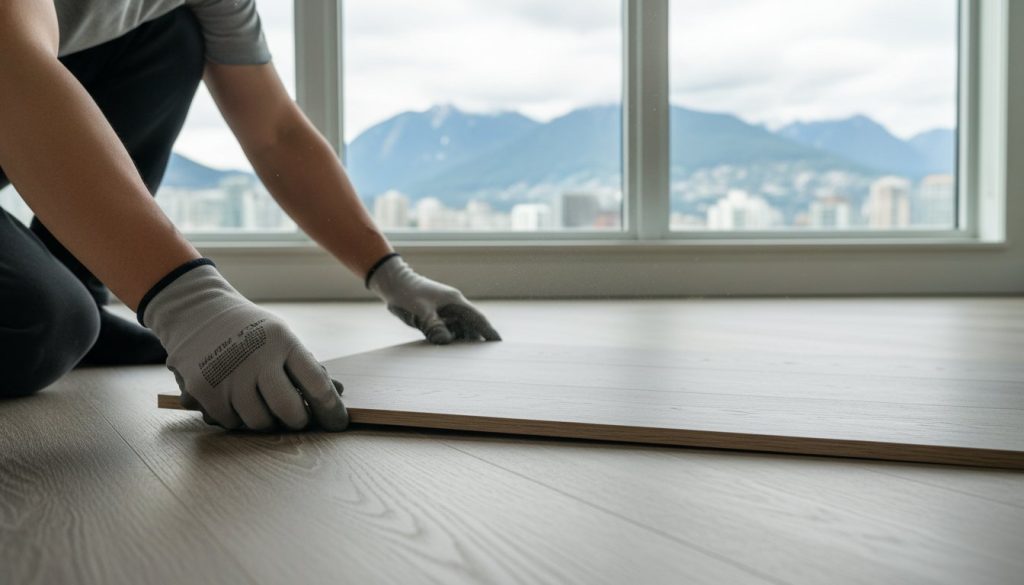
Last November, a homeowner in Kitsilano watched their brand-new planks separate by 3 millimeters because they didn’t account for the 85% relative humidity levels common during a Vancouver winter. It’s a frustrating reality for many who start installing composite flooring without considering the rigorous technical demands of our coastal climate. You likely already know that selecting a beautiful style is the most exciting part of a renovation, but you also understand that a floor is only as reliable as the foundation it rests upon.
We’re here to ensure your renovation doesn’t become a cautionary tale. You’ll master the specific technical requirements and local climate considerations required for a flawless, squeak-free finish in your Lower Mainland home. This guide explores the critical differences between SPC and WPC materials, provides the exact subfloor leveling standards for older Vancouver properties, and demonstrates how professional craftsmanship protects your investment for decades to come.
Key Takeaways
- Identify and resolve common Vancouver subfloor challenges, from sagging joists to uneven concrete, to guarantee a stable and long-lasting foundation for your home.
- Master the essential technical requirements for installing composite flooring, including why a 48-hour acclimatization period is non-negotiable in the Lower Mainland.
- Protect your investment by learning how to manage high relative humidity and prevent environmental issues like “peaking” or “gapping” in your planks.
- Gain professional insights into layout planning to avoid awkward “thin strips” at the edges and achieve a balanced, high-end look across every room.
- Understand how 15 years of local craftsmanship and precision can transform a standard renovation into a flawless, durable, and elegant living space.
What is Composite Flooring? Understanding Your Options in Vancouver
Composite flooring is a high-density fibreboard or stone-plastic core material topped with a photographic wear layer. Over the last 15 years, we’ve seen this material transform from a basic budget alternative into the premier choice for homeowners across the Lower Mainland. It’s a multi-layered synthetic product designed for maximum durability, combining the visual appeal of natural materials with the resilience of modern engineering. If you’re installing composite flooring in your home, you’re choosing a surface built to withstand the specific rigors of Pacific Northwest living.
The evolution of flooring technology has changed how we renovate. Traditional hardwoods, while elegant, often struggle with Vancouver’s 160 plus rainy days per year. Composite options have successfully filled this gap. They offer the aesthetic of white oak or walnut without the constant worry about moisture or scratches. In high-traffic households, these materials outperform traditional wood by a significant margin. High-quality composite floors often carry AC ratings of 4 or 5, which means they’re tough enough for both active families and large pets. This stability makes the renovation process feel manageable and exciting rather than a source of future maintenance stress.
Laminate vs. SPC vs. WPC: Which is Right for You?
Choosing the right core depends on your specific room. Traditional laminate is a cost-effective and stylish option for living areas, though it’s sensitive to standing water. SPC (Stone Plastic Composite) features a limestone-based core. It’s the ultra-durable, waterproof choice for Vancouver basements or kitchens. WPC (Wood Plastic Composite) includes a foaming agent for a softer, quieter underfoot feel. This makes it ideal for upper-floor bedrooms where comfort and sound reduction are priorities. If your existing laminate has already suffered moisture damage, professional laminate flooring repair lower mainland services can restore your floors before you decide whether to upgrade to a composite alternative.
Why Composite is Ideal for the BC Climate
Vancouver’s climate presents unique challenges for home interiors. Our seasonal temperature fluctuations can cause natural materials to expand and contract, leading to gaps or creaks. Composite flooring is dimensionally stable. It stays flat and secure through humid summers and damp winters. These moisture-resistant properties handle the rainy season without the warping or buckling often seen in older wood installations.
Many Burnaby estates and modern Vancouver condos now feature radiant heating systems. Composite materials are exceptionally compatible with these setups. They allow for efficient heat transfer without compromising the floor’s integrity. When installing composite flooring, you’re investing in a product that respects the local environment and its technical requirements. Your dream floors are just one step away when you choose a material built for the local lifestyle.
The Foundation of Success: Subfloor Preparation and Levelling
Your new floor’s lifespan depends entirely on the surface hiding beneath it. When installing composite flooring, homeowners often focus on the aesthetic finish, but the subfloor dictates the structural integrity. Vancouver’s diverse housing stock presents unique challenges. Older wood-frame homes in East Vancouver often suffer from sagging joists, while newer concrete builds in areas like Metrotown may have settled unevenly over the last 12 months. If you ignore these imperfections, even the highest-quality composite planks will eventually fail.
Professional installers follow a strict industry standard known as the “3/16 inch over 10 feet” rule. This means that across any 10-foot radius, the floor cannot deviate in height by more than 3/16 of an inch. Anything beyond this creates “hollow spots.” When you walk over these gaps, the floor flexes, putting immense pressure on the delicate click-lock joints. Over time, this repeated stress causes the planks to separate or crack. Utilizing professional floor leveling services burnaby ensures your foundation meets these rigid tolerances before the first plank is laid.
Moisture Testing and Barriers
Concrete acts like a sponge, especially in the humid Lower Mainland. We always perform calcium chloride or electronic moisture tests before installing composite flooring on a slab. If moisture emission levels exceed 3 lbs per 1,000 square feet over 24 hours, a 6-mil poly vapour barrier is mandatory. Homeowners should look for white powdery residue, known as efflorescence, or damp smells on the existing subfloor. These signs indicate that moisture is migrating upward, which can lead to mould growth or adhesive failure if not properly sealed with a moisture-rated underlayment.
Self-Levelling Compounds vs. Grinding
Fixing an uneven floor requires a two-pronged approach depending on the specific defect. We use diamond-cup grinders to shave down high spots or ridges in concrete slabs. For low spots or “dips,” we apply high-strength self-levelling underlayment. This liquid compound finds the lowest points and hardens into a glass-smooth surface. “Close enough” isn’t an option for modern composite systems. A deviation of just 1/8 inch can cause the locking mechanism to shear under regular foot traffic. We ensure the surface is perfectly flat to provide the “flawless foundation” your home deserves.
Getting the preparation right is the only way to guarantee your investment lasts for decades. If you aren’t sure if your subfloor is ready, you can request a professional site inspection to identify potential issues before they become costly mistakes.
Step-by-Step: The Process of Installing Composite Flooring
Successful installation begins long before the first plank clicks into place. Before you start installing composite flooring, you must allow the material to synchronize with your home’s specific climate. Acclimatization involves storing planks flat in the room where they will be installed for at least two days. This 48-hour period is non-negotiable in the Lower Mainland, where indoor humidity levels can fluctuate significantly between rainy and dry seasons. If you skip this, you risk the floor warping or buckling within the first year of use.
Layout planning is your next priority. Professional installers measure the room’s width and divide it by the width of a single plank to see how the final row will fit. If your math shows a remaining strip of less than two inches, you should trim your starting row to balance the room. This simple calculation prevents “thin strips” at the edges, which often look unbalanced and are structurally weaker. Additionally, always install a high-quality underlayment. A 2mm to 3mm foam or cork layer provides several benefits:
- Sound Dampening: It reduces footfall noise, which is a mandatory requirement for many strata buildings in North Vancouver and Burnaby.
- Thermal Insulation: It can improve floor surface temperature by up to 15 percent, making basement suites feel much cozier.
- Moisture Protection: It acts as a shield against subfloor dampness, which is common in coastal BC homes.
Setting the First Row and Expansion Gaps
Vancouver’s seasonal humidity shifts require your floor to have breathing room. You must maintain a 1/4 to 3/8 inch expansion gap between the flooring and every vertical surface, including walls and pipes. Use plastic spacers to keep this gap consistent as you work. If the floor is pinned too tightly against a wall, it will have nowhere to go when it expands, leading to peaked joints. Ensure your first row is perfectly straight by using a chalk line. Even a 1/16 inch deviation at the start can cause the floor to “drift” and create massive gaps by the time you reach the other side of the room.
Click-Lock Techniques and Staggering
Most modern composite brands use either “angle-angle” or “drop-lock” systems. Angle-angle requires you to insert the tongue into the groove at a 45-degree angle before pivoting the plank down. Drop-lock allows you to lay the plank flat and tap the end joint vertically. Regardless of the system, you must stagger your end joints by at least 12 inches. This creates a “staircase” pattern that ensures the floor’s structural integrity and mimics the look of authentic hardwood. When installing composite flooring near doorways, use an oscillating saw to undercut door jambs. This allows the plank to slide underneath for a seamless, professional finish that avoids awkward gaps around the trim. Working with a qualified flooring installer in Vancouver ensures these technical details are handled with precision from the very first plank.
Vancouver Climate Challenges: Managing Expansion and Humidity
Vancouver’s West Coast climate presents a unique set of variables for homeowners. With average outdoor humidity levels often exceeding 75% during the peak rainy season, the internal core of your planks faces constant environmental pressure. Even though modern materials are resilient, installing composite flooring requires a deep understanding of how these shifts impact your subfloor and the floor’s overall stability. If you ignore local conditions, you risk “peaking” where edges push upward or “gapping” where planks separate as they contract. These same climate forces are also responsible for the buckling and bouncing planks that make professional laminate flooring repair in the Lower Mainland such a common need for homeowners who didn’t account for Vancouver’s humidity during their original installation.
A major misconception involves the “waterproof” label found on many products. While the surface of the plank won’t swell from a spill, the subfloor beneath it remains vulnerable. Moisture trapped under a waterproof floor can lead to subfloor rot or adhesive failure if not addressed. To protect your investment, we recommend keeping your home’s relative humidity between 30% and 50%. High-quality HVAC management is your best defense against the moisture-prone environment of the Lower Mainland.
- Maintain consistent indoor temperatures between 18°C and 24°C during installation.
- Use a hygrometer to monitor daily humidity fluctuations.
- Ensure your subfloor moisture content is below 12% for wood or 3% for concrete before you begin.
Seasonal Movement in the Lower Mainland
Vancouver homes experience significant internal climate shifts throughout the year. During a cold Burnaby winter, indoor heating often drops humidity levels to 20%, causing planks to shrink. Conversely, the humid summer months cause them to expand. In large, open-concept floor plans exceeding 35 linear feet, transition mouldings are essential. These small gaps allow the floor to shift naturally without buckling against walls or kitchen islands when the heavy November rains arrive. Without these breaks, even the best floors can fail during their first year.
Basement Installations: SPC as the Local Hero
For basement suites in North Vancouver or Richmond, SPC (Stone Plastic Composite) is the superior choice. Its limestone-core construction provides significantly more stability than WPC when placed over cold concrete. We always utilize high-quality integrated underlayments to provide a thermal break and acoustic dampening. This setup prevents the floor from feeling icy underfoot. Proper perimeter ventilation ensures that any moisture near the foundation doesn’t lead to mould growth, protecting your home’s air quality and the long-term durability of the material.
With over 15 years of experience in the Lower Mainland, we know how to handle BC’s toughest environments. Your dream floors are just one step away.
Achieving a Flawless Finish: Professional Installation in Vancouver
While DIY projects offer a sense of personal accomplishment, installing composite flooring requires a level of technical precision that separates a standard room from a high-end masterpiece. A “good” DIY job often results in minor visible gaps, slightly uneven transitions, or boards that bounce because the subfloor wasn’t perfectly prepped. A flawless professional result ensures every plank sits flush and remains stable for decades. Saba Flooring utilizes 15 years of local experience to handle complex layouts that often frustrate homeowners, such as integrated staircases, curved walls, and multi-room transitions.
Our commitment to craftsmanship includes a professional warranty on both labour and materials. This provides long-term security that a weekend project simply cannot match. We also focus on the critical final touches that complete the aesthetic. These include:
- Precision-cut baseboards that hide expansion gaps perfectly.
- Shoe mouldings that provide a clean, finished edge against cabinetry.
- Custom transition strips that create a seamless flow between different flooring types.
Why Hire a Local Vancouver Flooring Contractor?
Vancouver’s specific climate and diverse housing stock require specialized knowledge. Our teams arrive with commercial-grade levelling equipment and digital moisture meters to assess the environment before the first board is laid. This technical approach is essential for the unique architecture found in the Lower Mainland. We understand how to stabilize the uneven joists of a Vancouver Heritage home and how to meet the strict sound-rating requirements of modern concrete condos. Whether you need a hardwood floor installation vancouver specialist or a composite expert, our local expertise ensures your project is built to last.
Your Dream Floors are Just One Step Away
The process of transforming your home begins with a precise, transparent quote. We evaluate your specific space in the Lower Mainland to provide an accurate estimate that avoids hidden costs. Most residential composite projects follow a streamlined timeline, typically wrapping up within 3 to 5 business days depending on the square footage. We manage the heavy lifting, from old floor removal to the final cleanup, leaving you with a durable and elegant space. Our goal is to make the renovation process feel manageable and exciting rather than overwhelming. Your dream floors are just one step away.
Start Your Vancouver Home Transformation Today
Achieving a high-quality finish requires more than just picking a beautiful plank. Success depends on meticulous subfloor preparation and a professional approach to managing Vancouver’s specific humidity levels. When you’re installing composite flooring, precision is the difference between a floor that shifts and one that remains flawless for decades. Our team brings 15 years of local Vancouver experience to every job site, ensuring your home benefits from specialists in precision floor levelling and 5-star rated craftsmanship across the Lower Mainland.
We take the stress out of your renovation by acting as your helpful guide through every technical stage. Whether you’re upgrading a moisture-prone basement or a sun-drenched living room, we deliver durable results that reflect our pride in craftsmanship. Don’t risk your investment with guesswork; trust the seasoned experts who understand the unique needs of British Columbia homeowners. Your dream floors are just one step away.
Frequently Asked Questions
Is composite flooring the same as laminate flooring?
No, composite flooring and laminate are different products with unique core constructions. Composite flooring, such as SPC, features a limestone or wood dust core, while laminate uses a high-density fiberboard core. This makes composite 100% waterproof, unlike traditional laminate. In our 15 years of experience serving the Lower Mainland, we’ve seen composite handle the 1,153 mm of average annual rainfall in Vancouver much better than wood-based alternatives.
Do I really need to level my floor before installing composite planks?
Yes, you must level your subfloor to within 3 mm over a 3-meter radius to prevent plank failure. Installing composite flooring on an uneven surface causes the locking mechanisms to crack under pressure. Our team uses self-leveling compounds to ensure a flawless foundation, preventing the bouncing sensation that occurs when planks bridge small dips in your subfloor. This meticulous preparation is part of our commitment to expert craftsmanship.
How long does it take to install composite flooring in a standard Vancouver home?
A professional team can typically install 500 to 800 square feet of flooring per day. When installing composite flooring in a standard 1,200-square-foot Vancouver condo, the entire process usually takes 2 to 3 business days including trim work. This timeline assumes the subfloor is prepped and the material has acclimated to your home’s humidity for 48 hours. Your dream floors are just one step away.
Can I install composite flooring over my existing tile or linoleum?
You can install composite planks over existing hard surfaces if they’re flat, stable, and well-bonded to the subfloor. Grout lines in tile must be filled if they’re wider than 5 mm to prevent the new flooring from sagging into the gaps. This approach saves time and reduces demolition waste in Burnaby and Vancouver renovation projects. It’s an efficient way to transform your space without the mess of a full tear-out.
What is the best way to clean and maintain composite floors in BC?
Use a pH-neutral cleaner and a damp microfiber mop to remove the salt and grit brought in during Vancouver winters. Avoid steam mops or abrasive scrubbers, as they can damage the 20-mil wear layer over time. Regular sweeping prevents scratches from debris, ensuring your upgrade retains its elegant, high-quality finish for decades. This simple routine keeps your home looking flawless while protecting the material’s integrity against local climate challenges.
Do I need an underlayment if my composite flooring has a pre-attached pad?
You generally don’t need additional underlayment if your planks include a pre-attached IXPE or cork pad. Adding a second layer of foam can make the floor too soft, which puts unnecessary stress on the click-lock joints. However, if you’re in a North Vancouver high-rise, your strata might require a specific sound-rated membrane to meet IIC ratings of 70 or higher. Always verify these requirements with your building council first.
How much expansion gap should I leave for a Vancouver condo?
Leave a 6 mm to 10 mm expansion gap around the entire perimeter of the room. This space allows the floor to shift naturally as Vancouver’s relative humidity fluctuates between 40% and 60% throughout the year. We hide these gaps using color-matched baseboards or quarter-round molding to deliver a professional, seamless look that protects your investment. Proper spacing prevents the planks from buckling during the more humid summer months.
Can composite flooring be installed over radiant floor heating?
Most modern composite planks are compatible with hydronic radiant heat systems if the surface temperature doesn’t exceed 27 degrees Celsius. Check the manufacturer’s 2026 specifications before starting your project to ensure the warranty remains valid. Proper installation ensures your home stays warm and comfortable during those chilly Lower Mainland months. We always recommend a slow temperature increase over 72 hours to allow the material to adjust to the heat source safely.