Last November, a homeowner in Kitsilano watched as Vancouver’s 160mm of monthly rainfall turned a minor window leak into a buckled section of their heritage oak flooring. It’s a common story across the Lower Mainland, where high humidity and heavy foot traffic eventually take a toll on even the finest surfaces. You likely chose your flooring for its timeless elegance, so seeing deep gouges or hearing a persistent squeak every time you walk across the room is frustrating. Whether you’re dealing with water-damaged planks or unsightly scratches, a professional hardwood floor repair can transform your living space and restore that flawless finish you remember.
We agree that your home deserves more than temporary patches that fail after a single season. This guide promises to help you master the art of restoration by providing expert insights on subfloor stabilization and climate-specific refinishing techniques tailored for our coastal environment. You’ll learn how to evaluate the cost-to-value ratio of your project and find a reliable expert who values precision as much as you do.
Key Takeaways
- Learn how Vancouver’s high humidity levels impact wood expansion and why a multi-step restoration process is vital for maintaining seasonal stability.
- Discover professional “lacing in” techniques and precision tools that ensure a seamless, flawless transition during your hardwood floor repair project.
- Master the decision framework for repairing solid hardwood versus replacing engineered floors by evaluating cost-effectiveness and wear layer limitations.
- Understand the critical role of subfloor stabilization in eliminating squeaky boards and providing the flat foundation necessary for a long-lasting finish.
- Identify the essential criteria for hiring a local specialist, including the importance of a 15-year local portfolio and a detailed on-site physical inspection.
Understanding Hardwood Damage in the Vancouver Climate
Professional hardwood floor repair is a technical, multi-step restoration process. It goes beyond simple sanding to address the structural and aesthetic integrity of your home’s foundation. In the Lower Mainland, our floors face a relentless cycle of moisture. Vancouver’s high humidity levels cause organic Wood flooring to expand and contract as the seasons shift. This constant movement can lead to gaps, squeaks, and cracked finishes if the material isn’t managed correctly. At Saba Flooring, we’ve spent 15 years observing how our local weather patterns affect different timber species. We categorize damage into two groups: surface-level wear like scratches or fading, and deep structural issues that require professional intervention to save the floor.
- Structural damage: Includes soft spots, severe rot, or subfloor failure.
- Aesthetic wear: Involves traffic patterns, light scratches, and UV discoloration.
- Environmental stress: Results in seasonal gapping or minor board movement.
The Impact of BC Humidity on Wood Stability
The Equilibrium Moisture Content (EMC) in Vancouver fluctuates significantly between our damp winters and drier summers. Most local homes maintain an indoor EMC between 8% and 12%. When the top of a floorboard becomes wetter than the bottom, a condition called “crowning” occurs. This makes the center of the board arch upward. To prevent this during a hardwood floor repair, we insist on acclimatizing all replacement wood to your specific home environment for at least 72 hours. This step ensures the new boards won’t shrink or swell aggressively after the job is finished. Our team uses precision moisture meters to verify that the new timber matches your existing floor’s hydration levels exactly. The same humidity-driven challenges that affect hardwood are equally relevant to laminate flooring repair in the Lower Mainland, where even a 15% shift in indoor humidity can cause improperly acclimated planks to buckle by several millimetres.
Identifying Water Damage and Mold Risks
Vancouver heritage homes in neighborhoods like Kitsilano or Mount Pleasant often hide moisture-related wood rot. Rain-soaked entryways are the primary culprit. If water sits on the surface, it eventually seeps through the gaps and reaches the subfloor. Once the plywood underneath becomes saturated, mold risks increase and the structural stability of the room is compromised. You can spot early signs by looking for dark staining around the board edges or a musty odor near the baseboards. Wood cupping is the result of moisture imbalance across the board thickness where the edges sit higher than the center. If you notice this “wavy” texture, it’s a signal that moisture is trapped beneath the planks. Addressing these issues early transforms a potential replacement project into a manageable restoration. Your dream floors are just one step away.
Professional Repair Techniques: From Scratches to Plank Replacement
Precision is the hallmark of high-quality hardwood floor repair. At Saba Flooring, we utilize HEPA-filtered dustless sanding systems and specialized oscillating saws to ensure every cut is surgical. This technology prevents 99.7% of dust particles from entering your living space, making the restoration process safe for families across Vancouver and the Lower Mainland. Our technicians use professional-grade wood fillers and epoxy resins to address deep gouges, ensuring the filler bonds permanently with the wood fibers rather than popping out during seasonal shifts.
The Art of Board Replacement and Lacing
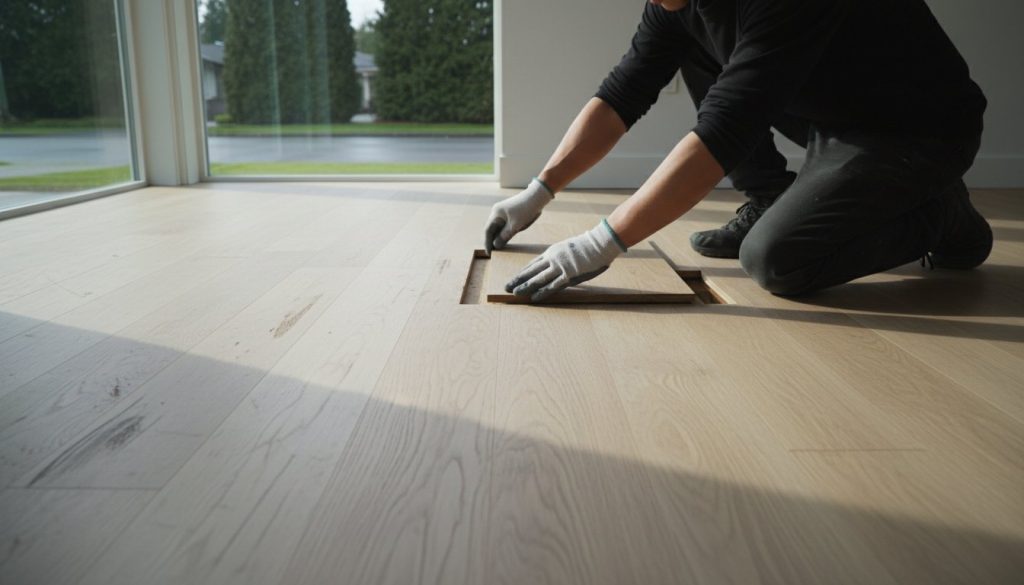
When a plank suffers structural damage from moisture or heavy impact, we don’t just “patch” the area. We use a sophisticated lacing technique, often called feathering. This process involves removing damaged boards by carefully cutting through the tongue and groove joints with a toe-kick saw to avoid damaging adjacent planks. We source matching species like White Oak, Maple, or Walnut, which are common in high-end BC estates. By staggering the new joints across the floor, we maintain the structural integrity and visual flow of the original installation. This meticulous approach prevents the “patchwork” look that often results from DIY attempts.
Refinishing and Color Matching
Matching the aged patina of a 20-year-old floor requires a deep understanding of wood chemistry. New wood is lighter and less amber than original planks that have oxidized over time. We follow official guidelines on finishing wood to ensure chemical compatibility between old fibers and new sealants. In the humid climate of the Pacific Northwest, we frequently recommend high-durability water-based finishes. These products dry faster and emit significantly fewer VOCs than traditional oil-based options. While spot-refinishing works for minor surface scuffs, deep gouges usually require a full room sand-and-finish to achieve a flawless, uniform sheen across the entire surface.
Our team brings 15 years of experience to every project in Burnaby and the surrounding regions. We transform worn, scratched surfaces into durable masterpieces that reflect your home’s unique character. Your dream floors are just one step away when you consult with a local hardwood expert to evaluate your restoration needs.
The ‘Repair vs. Replace’ Dilemma: A Decision Framework
Deciding whether to salvage your current flooring or start fresh is a pivotal moment in any home renovation. In the high-stakes Vancouver real estate market, the quality of your floors directly impacts your property’s appraisal value. High-quality solid hardwood is a legacy material that often justifies the cost of a meticulous hardwood floor repair. Restoring original planks preserves the architectural soul of older homes in neighborhoods like Kitsilano or Mount Pleasant while costing significantly less than a full teardown. However, the decision isn’t purely aesthetic; it’s structural.
The “point of no return” typically occurs when structural damage reaches the subfloor or when more than 30% of the planks are warped, split, or affected by deep pet stains. If the cost of labor, localized patching, and custom staining begins to approach 70% of the price of a total replacement, a fresh installation becomes the more logical financial path. We help homeowners weigh these variables to ensure their investment yields the highest possible return in durability and style.
Evaluating the Wear Layer
The longevity of your floor depends entirely on the thickness of its wear layer. This is the portion of wood sitting above the tongue and groove. A standard 3/4 inch solid hardwood floor can typically withstand 4 to 6 professional sandings over its lifetime. This isn’t the case for the engineered products frequently found in newer Burnaby condos. These floors have a thin veneer of real wood bonded to a plywood or composite core. If the wear layer is less than 2mm, replacement is usually the safer long-term investment. Sanding a floor that’s already too thin risks exposing the tongue and groove, which leads to structural failure and unsightly gaps that no amount of wood filler can fix. If your property features laminate rather than engineered wood, our guide to professional laminate flooring repair across the Lower Mainland outlines the specific wear layer thresholds and moisture considerations that determine whether restoration or replacement is the right call.
Cost-Benefit Analysis for Lower Mainland Properties
When analyzing the numbers, professional refinishing generally costs between C$4 and C$8 per square foot, depending on the finish and level of damage. In contrast, a new hardwood floor installation in Vancouver involves higher material costs, demolition fees, and longer timelines. Repairing localized damage is an efficient way to transform a room without the disruption of a full-scale construction project. Beyond the financial savings, there’s a significant environmental benefit. Restoring existing timber keeps perfectly functional wood out of BC landfills and reduces the demand for new logging. For many homeowners, the ability to upgrade their home’s elegance while maintaining a smaller ecological footprint is the deciding factor. A well-executed hardwood floor repair can make 20-year-old oak look brand new, providing a flawless surface that attracts premium buyers in a competitive market.
Why Subfloor Leveling is the Secret to a Successful Repair
Many homeowners assume that a professional hardwood floor repair only involves the visible surface. This is a common misconception that leads to recurring issues. If your floor feels bouncy or makes a sharp squeaking sound when you walk across the room, the problem is rarely the wood itself. It’s the foundation. An uneven subfloor puts constant, localized stress on the tongue-and-groove joints of your planks. Without a flat foundation, even the most expensive restoration will fail. We’ve seen many cases where skipping subfloor preparation leads to the exact same repair being needed again within 12 months as the new wood flexes and eventually cracks under pressure.
At Saba Flooring, we treat the subfloor as the most critical stage of the restoration process. We use high-strength self-leveling compounds to fix dipping subfloors, ensuring the top layer sits perfectly flush. This stability is what differentiates a temporary fix from a lifetime solution. By taking the time to create a level plane, we protect your investment and ensure the structural integrity of your home’s interior.
Correcting Foundation Dips and Peaks
In the Lower Mainland, we typically encounter three primary subfloor materials: plywood, OSB, or concrete slabs. Each material reacts differently to Vancouver’s coastal humidity and requires a specific leveling strategy. For concrete foundations, our team often employs industrial grinding to remove high peaks that cause planks to “bridge” and hollow out. For plywood or OSB, we focus on filling low spots with specialized compounds that bond permanently to the wood. If your home has a concrete subfloor showing signs of cracking or moisture intrusion, our comprehensive guide to concrete repair near me in Vancouver covers the specific restoration techniques that prevent future structural failures. You can find deep technical insights on these procedures in our guide to expert floor leveling services in Burnaby. This meticulous approach creates the flawless, flat surface necessary for a high-quality hardwood floor repair.
Eliminating Squeaks and Movement
Squeaks are almost always caused by friction between a loose subfloor and the floor joists. Before we lay any new wood, we secure the existing foundation using specialized flooring screws that won’t back out over time. We also integrate professional-grade underlayments to act as a noise-reducing barrier. This stability is vital because it prevents the new finish from cracking at the seams. When a subfloor moves, the finish joints separate, allowing moisture to seep into the core of the wood. Our process eliminates this movement entirely, preventing joint separation and ensuring your floors remain silent and stable. With our 15 years of experience, we know that a quiet floor is the true hallmark of expert craftsmanship.
Choosing the Right Vancouver Flooring Contractor for Restoration
Selecting a specialist for your hardwood floor repair requires more than a quick internet search. You need a partner with at least 15 years of experience in the local market. A deep local portfolio proves a contractor understands how Vancouver’s unique coastal climate, characterized by rainy winters and humid summers, affects wood expansion and stability. Don’t rely on a rough phone estimate. These figures often overlook critical subfloor issues or structural moisture damage that only a physical on-site inspection reveals. Accurate assessments prevent surprise costs later in the project.
Saba Flooring bridges the gap between old-world techniques and future-facing solutions. While we respect the heritage of wood, we integrate 3D design technology to help you visualize the restoration before work begins. This modern approach ensures that every repair aligns with your home’s existing aesthetic. We don’t just patch holes; we restore the architectural integrity of your space using precision tools that minimize dust and maximize accuracy.
The Saba Flooring Craftsmanship Advantage
Our commitment to excellence starts with meticulous surface preparation. We know that a flawless finish is only possible if the foundation is perfect. Serving Vancouver, Burnaby, and the entire Lower Mainland, our teams specialize in seamless transitions between old and new wood. We handle everything from simple scratch remediation to complex structural tasks. If your project involves intricate designs, our team is highly skilled in professional parquet flooring installation and restoration. We use high-grade, durable sealants that protect your investment against the high-traffic demands of a modern household. Our 15 years of experience means we’ve seen every possible floor type and damage scenario in the region.
Booking Your Consultation
The process of getting a quote for your hardwood floor repair is simple and transparent. We don’t use high-pressure sales tactics. Instead, we act as a helpful guide to simplify the renovation process. When you book a consultation, our experts visit your home to conduct a thorough walkthrough. We explain the technical requirements of your specific wood species and provide a detailed plan of action. We want you to feel empowered and informed before any work starts. Our goal is to make your home renovation feel manageable and exciting rather than overwhelming. Your dream floors are just one step away; contact our Vancouver team today to start your transformation.
Bring New Life to Your Vancouver Hardwood Today
Restoring your home’s character starts with addressing the specific moisture challenges of our Pacific Northwest climate. You’ve seen how proper subfloor leveling prevents future shifting and why professional hardwood floor repair is a sustainable, cost-effective choice compared to a full replacement. With 15 years of expert craftsmanship across the Lower Mainland, Saba Flooring understands the technical precision required for a flawless result. We utilize advanced dustless sanding technology and high-quality, durable finishes to ensure your living space remains clean and beautiful throughout the process. Our team specializes in Vancouver-specific environmental factors, providing restoration solutions that stand the test of time. We’ve spent over a decade perfecting methods that protect your investment from seasonal expansion and contraction. Your dream floors are just one step away. Let’s make your home’s interior look elegant and feel brand new again.
Restore your hardwood floors today; request a professional quote from Saba Flooring.
Frequently Asked Questions
Is it better to repair or replace my hardwood floors?
It’s generally better to repair your floors if the structural damage affects less than 30% of the total surface area. Most solid hardwood can be sanded and refinished 4 to 6 times before the wood becomes too thin. If your boards are at least 1/8 inch thick above the tongue, a professional hardwood floor repair will restore their original beauty for a fraction of the replacement cost.
How much does it cost to repair hardwood floors in Vancouver?
Professional hardwood floor repair in the Lower Mainland typically ranges from C$500 for minor scratches to C$5.00 per square foot for full restoration. According to 2024 industry data from HomeStars, Vancouver homeowners often spend between C$1,500 and C$4,000 on comprehensive refinishing projects. These costs depend on the wood species, the type of finish used, and the specific labor required for your home’s layout.
Can you fix hardwood floors that have water damage?
We can fix water-damaged floors provided the subfloor is structurally sound and the wood moisture content has stabilized. Minor cupping often disappears after professional sanding once the wood dries below a 12% moisture threshold. If the boards show dark mold spots or severe crowning, we replace those specific sections and blend them with your existing floor to ensure a flawless result.
How long does a professional hardwood floor repair take?
Most hardwood floor repair projects require 2 to 5 days to complete depending on the size of the area. While the physical labor for a patch might take 4 hours, the drying time for stains and protective coatings accounts for the majority of the schedule. We follow a logical process that ensures each layer cures properly, giving you a durable finish that stands the test of time.
Can you match the color of my existing hardwood during a repair?
We achieve a color match of 95% or higher by creating custom stain blends and testing them directly on your floor’s wood species. Because wood naturally changes color due to UV exposure over 5 to 10 years, we don’t rely on off-the-shelf products. Our experts apply several test swatches to ensure the new boards integrate seamlessly with the aged patina of your original flooring.
Do I need to move all my furniture for a small hardwood patch?
You only need to clear furniture from the immediate repair zone and a 3-foot buffer area around it. If the project involves sanding a larger section, we recommend removing all items to protect them from fine particles. Our team uses HEPA-filtered vacuum systems that capture 99% of dust, but an empty room allows us to work with the precision needed for a professional finish.
Why are my floorboards squeaking, and can it be fixed without replacing the floor?
Squeaking usually happens when boards rub together or pull away from the subfloor, and it’s a problem we fix without a full replacement in 90% of cases. We use specialized lubricants or counter-sunk screws to secure the loose boards directly to the joists. This simple yet effective method eliminates noise and restores the solid, high-quality feel you expect from your home’s flooring.
How do I maintain my repaired hardwood floors in Vancouver’s humidity?
Keep your home’s humidity between 35% and 55% to prevent the wood from swelling or shrinking in our coastal climate. You should use a dehumidifier during Vancouver’s damp winter months and avoid wet mopping, which can trap moisture in the grain. With 15 years of experience in the Lower Mainland, we’ve found that consistent climate control is the best way to keep your restored floors looking elegant. Your dream floors are just one step away.