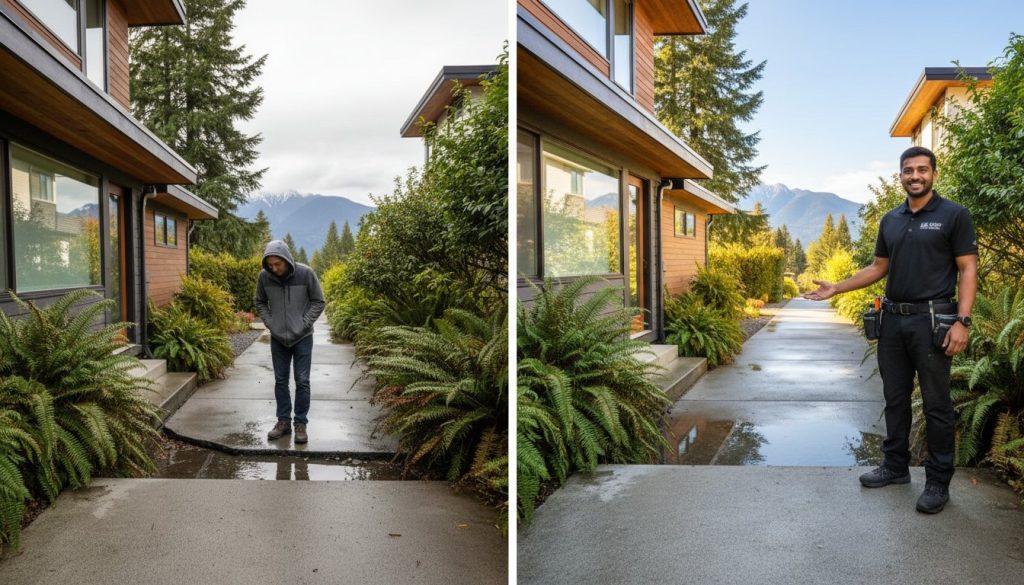
Last November, a homeowner in North Vancouver watched as a single heavy rainfall turned her sunken driveway into a C$2,000 liability. Between the tripping hazards on the walkway and water pooling dangerously close to the foundation, the situation felt like an expensive disaster. You likely feel that same frustration when you look at your uneven patio or a subfloor that’s stalling your hardwood installation. It’s a common headache in the Lower Mainland where shifting soil is part of the landscape, but professional concrete leveling offers a reliable way to fix the problem without the mess of a full demolition.
We understand that maintaining a safe and beautiful home is your top priority. This guide shows you how to restore your surfaces for up to 70% less than the cost of a total replacement. You’ll learn how to identify if your specific slab is a candidate for repair, compare current Vancouver market conditions, and discover the steps to achieve a flawless finish that protects your property value. Your dream floors are just one step away.
Key Takeaways
- Save significantly on your renovation budget by opting for restoration instead of the high cost and lengthy timelines of a full concrete pour.
- Understand how Vancouver’s unique “Rain City” climate and soil erosion impact the structural integrity of your home’s exterior and interior slabs.
- Explore the non-invasive, two-step injection method that can transform and stabilize your sunken surfaces in a single afternoon.
- Discover why professional concrete leveling is a mandatory prerequisite for achieving a flawless, long-lasting hardwood or laminate flooring installation.
- Learn to identify the specific causes of settlement in newer Burnaby and Coquitlam developments to protect your property’s long-term value.
What is Concrete Leveling and Why Does it Matter for Vancouver Homes?
Concrete leveling is a non-invasive foundation correction method designed to lift and stabilize settled slabs by injecting specialized material beneath the surface. In 2026, this technology has become the primary choice for homeowners across the Lower Mainland who want to restore the safety and structural integrity of their property without the chaos of a full demolition. Whether you are dealing with a sinking driveway in Burnaby or a slanted patio in North Vancouver, understanding What is Concrete Leveling helps you protect your investment from the region’s high-moisture climate.
Vancouver homeowners are increasingly choosing restoration over replacement. The city’s heavy rainfall and varying soil compositions often lead to subfloor erosion, causing concrete slabs to tip or sink. Instead of pouring new concrete, which requires a lengthy curing process, leveling provides an immediate solution. This process is essential for high-traffic areas such as driveways, garden patios, and interior basement subfloors where a trip hazard can become a significant liability. With over 15 years of experience in the local industry, we have seen how quickly a minor settlement can turn into a major structural issue if left unaddressed.
The Terminology of Concrete Restoration
The industry uses several terms that often confuse residents. Mudjacking is the traditional method using a slurry of sand and water, while slabjacking is a broader term for the mechanical lifting of concrete. Poly-leveling is the modern standard in 2026, utilizing high-density polyurethane foam for a lightweight, waterproof result. Local BC contractors typically use the term “concrete jacking” to describe these services. You can identify if your slab is a candidate by looking for these visual signs:
- Cracks wider than 0.5 centimeters running across the slab.
- Pooling water or “birdbaths” that refuse to drain after a typical Vancouver downpour.
- Visible gaps between the concrete walk and the home’s foundation.
- Uneven sections where one slab has dropped 2 centimeters or more below the adjacent piece.
The Economic Advantage in the Lower Mainland
Choosing restoration provides a massive financial benefit. Concrete disposal fees in Metro Vancouver have risen steadily, making the removal of old slabs a costly logistical hurdle. Leveling bypasses these high disposal costs entirely. Most experts follow the “70% Rule”: if the cost of restoration is less than 70% of the cost of a full demolition and pour, leveling is the superior economic choice. In many cases, homeowners save between 50% and 60% compared to traditional replacement. This efficiency allows you to allocate your budget toward other upgrades, like porcelain tile or elegant hardwood. Your dream floors are just one step away when you start with a perfectly level foundation.
The Why Behind the Sag: Causes of Concrete Settlement in BC
Vancouver homeowners know that “Rain City” isn’t just a nickname; it’s a geological challenge for any outdoor structure. With an average of 168 rainy days per year, the Lower Mainland’s environment works against your concrete slabs from the moment they’re poured. When water saturates the ground, it changes the soil’s volume and structural integrity. This constant movement leads to the sinking and cracking that makes concrete leveling a necessary part of long-term property maintenance. Understanding these local factors is the first step toward a permanent fix for your home.
Moisture and Soil Washout
Heavy seasonal rains create a relentless cycle of erosion beneath your property. As water flows under your driveway or patio, it carries away fine sediment and creates empty pockets known as voids. Without the necessary support, the heavy concrete eventually drops into these spaces. Hydrostatic pressure also plays a significant role in our coastal environment. During the wet months, the weight of the water in the soil exerts immense force against your slabs. When this pressure subsides, the soil often fails to return to its original state. Learning the basics of leveling a concrete floor helps homeowners realize that surface patches won’t solve these deep-seated drainage issues. Professional concrete leveling solutions must fill these voids to prevent future sinking.
Soil Types Across the Lower Mainland
The ground beneath your feet varies significantly depending on your specific neighborhood. In newer developments throughout Burnaby and Coquitlam, settlement often stems from poorly compacted backfill used during the initial construction phase. If a contractor didn’t properly compress the earth before pouring, the weight of the slab causes it to sink within 5 to 10 years. In older Vancouver West Side neighborhoods, the culprits are often organic. Decaying tree roots from decades-old maples leave behind hollow channels as they rot, removing the subfloor support your concrete relies on. High moisture levels in BC soil lead to slab instability by causing clay-heavy soils to expand and sandy deposits to shift unexpectedly.
While Vancouver remains milder than the rest of Canada, we still face approximately 25 freeze-thaw cycles annually. Water enters small cracks, freezes, and expands by roughly 9 percent. This expansion pushes the concrete upward, while the subsequent thaw leaves the slab unsupported. Over time, this “jacking” effect destroys the integrity of your walkways and stairs. If you’ve noticed your patio tilting or your driveway catching your car’s bumper, it’s time to consult with a local specialist who understands these unique coastal conditions and can restore your home’s safety.
Concrete Leveling vs. Replacement: Making the Right Choice
Deciding between concrete leveling and a full replacement often comes down to the structural integrity of your slab. If your driveway or patio is still solid but has simply tilted due to soil erosion, leveling is the superior path. You’ll save time and money while avoiding the mess of a construction zone. A typical leveling project in Vancouver takes about three hours from start to finish. In contrast, a new pour requires several days for demolition, framing, and curing before you can even walk on it. Choosing restoration also aligns with British Columbia’s environmental goals. It prevents thousands of pounds of debris from entering local landfills and reduces the carbon footprint associated with manufacturing new cement.
However, leveling isn’t a universal fix. You should opt for replacement if you notice the following issues:
- The surface is crumbling or “spalling” extensively due to age or salt damage.
- There are deep, web-like cracks that indicate the concrete has lost its structural bond.
- Visible rebar is rusting and expanding, which causes the concrete to burst from within.
- The slab has broken into dozens of small pieces, making it impossible to lift as a single unit.
The Cost-Benefit Analysis for Vancouver Property Owners
In Vancouver, new concrete work often triggers the need for municipal permits and site inspections. These administrative steps add costs and weeks of potential delays to your project. When you choose Canadian Concrete Leveling, you’re opting for a benchmark of local quality that bypasses much of that red tape. A professional lift can last over a decade. It’s a permanent fix for the underlying soil voids, provided the drainage issues are addressed. This makes it a high-value investment for those who want to stabilize their property without the C$5,000 to C$15,000 price tag often associated with major tear-outs.
Curb Appeal and Property Value
Uneven slabs are more than just an eyesore; they’re a significant liability for Burnaby homeowners. Real estate experts note that trip hazards on a walkway can decrease a home’s perceived value by 5% during a sale. Some owners fear a “patchwork” look, but modern concrete leveling uses penny-sized injection holes. These are filled with color-matched grout, making the repair virtually invisible. We recently worked with a homeowner in North Vancouver whose driveway had sunk 10 centimeters near the garage. We restored the height in one afternoon. The owner was able to park their car on the slab the same evening, and the curb appeal was instantly transformed.
A Step-by-Step Guide to the Concrete Leveling Process
Restoring a sunken slab is a precise operation that requires a balance of technical skill and high-quality materials. At Saba Flooring, we’ve refined our process over 15 years to ensure your walkways and driveways are safe and level with minimal disruption. The goal of concrete leveling is to address the underlying void without the cost or waste of a full replacement.
- Step 1: Strategic drilling of entry ports. Our technicians begin by mapping the slab to identify the most effective lift points. We drill small, penny-sized holes, usually about 15 to 18 millimeters in diameter, in a specific pattern. These small ports are the only structural changes made to your existing concrete.
- Step 2: Injection of structural materials. We inject either a specialized limestone slurry or high-density polyurethane foam through the ports. This material fills the empty pockets beneath the slab, creating a stable foundation that pushes the concrete upward.
- Step 3: Monitoring the lift. This is a real-time process. We use precision levels to watch the slab as it rises, ensuring it aligns perfectly with the surrounding surfaces. We stop the injection the moment the finish is flush to prevent over-lifting.
- Step 4: Patching and color-matching. After the slab is stable, we clean the ports and fill them with a durable concrete grout. We take pride in matching the color of the patch to your existing surface, making the repair sites nearly invisible to the naked eye.
Materials Used in 2026 Leveling
Modern restoration has moved beyond simple mudjacking. While traditional stone slurry is excellent for heavy-duty applications, we often recommend modern expanding structural foam for residential projects in the Lower Mainland. These materials are chosen specifically because they’re hydrophobic. In a climate like Vancouver’s, where we see significant annual rainfall, you need a material that won’t wash away or erode when the soil gets saturated. These compounds react and harden quickly, creating a waterproof barrier that protects your subfloor from future shifting.
What to Expect on Service Day
Preparation is straightforward for most homeowners. We ask that you clear the immediate area of vehicles or patio furniture. Before we start, we identify underground utilities to ensure the safety of your property. The noise levels are manageable, typically sounding no louder than a standard gas-powered lawnmower. This makes the process ideal for quiet residential neighborhoods in Burnaby or North Vancouver. Efficiency is a hallmark of our service; you can walk on the leveled slab just 15 to 30 minutes after we finish. For driveways, we recommend waiting 24 hours before parking a vehicle on the surface to ensure the material has fully cured. If you’re ready to fix your uneven surfaces, contact Saba Flooring for a professional concrete leveling estimate.
Preparing Your Subfloor for New Flooring: The Saba Flooring Advantage
A beautiful floor is only as good as the surface beneath it. If you’re planning an upgrade in your Vancouver home, you can’t afford to overlook the state of your concrete. Sunken or uneven slabs aren’t just aesthetic issues; they’re structural obstacles that can ruin expensive materials. Concrete leveling ensures that your investment in hardwood, laminate, or luxury vinyl remains stable for decades. Without a flat surface, your new planks will shift, creak, and eventually fail.
Skipping professional leveling often leads to the dreaded “bouncy” floor effect. This happens when there are voids or dips between the subfloor and the flooring material. Every time you walk across the room, the floorboards flex into those gaps. This constant movement puts immense pressure on the interlocking joints of laminate and engineered wood. In many cases, this stress causes the tongues and grooves to snap within the first two years of installation. Saba Flooring integrates precision leveling into our full interior transformations to prevent these costly repairs before they start.
Vancouver presents unique challenges for subfloors. Local condos often have slight variances in their concrete slabs from the original pour, while heritage homes in neighborhoods like Kitsilano or Shaughnessy deal with over 80 years of foundation settling. We provide custom solutions that respect the specific needs of these properties. Whether it’s a high-rise unit requiring low-noise leveling methods or a historic house needing significant stabilization, we bring 15 years of local experience to every project.
The Foundation of a Flawless Finish
Achieving a perfect result requires a technical approach. We often pair concrete leveling with Professional Hardwood Floor Installation in Vancouver to ensure the best possible outcome. While concrete jacking handles major structural sinks, we use high-grade self-leveling compounds to smooth out smaller imperfections and ridges. This meticulous process is vital for maintaining your warranty. Most premium wood brands require the subfloor to be flat within 3/16 of an inch over a 10-foot radius. If your subfloor doesn’t meet these strict standards, the manufacturer may void your warranty if the floor fails.
Your Next Steps with Saba Flooring
Choosing a contractor who understands the entire flooring lifecycle is the smartest way to protect your home. We don’t just look at the concrete; we look at how that concrete will interact with your chosen finish. Our team provides a comprehensive view of your project, from the initial slab assessment to the final trim. This holistic approach eliminates the finger-pointing that often happens between separate leveling and flooring crews. We take full accountability for the stability and beauty of your interior.
- Get a detailed, local estimate tailored to the specific soil and building conditions of the Lower Mainland.
- Work with seasoned experts who prioritize precision and long-term durability.
- Ensure your home meets all modern building codes and manufacturer specifications.
Your dream floors are just one step away. Don’t let an uneven subfloor stand in the way of a flawless home transformation. Contact Saba Flooring for a free Vancouver floor assessment today and let our experts guide you through a stress-free renovation process.
Restore Your Property’s Integrity and Value for 2026
Don’t let sunken slabs compromise your home’s safety or curb appeal. Addressing soil settlement early prevents expensive structural damage and ensures your property remains a stable investment in the competitive BC market. Choosing concrete leveling over a full replacement saves you time and reduces waste; it provides a durable solution that’s often ready for use within a single day. Investing in these repairs now protects your foundation and prepares your space for any future upgrades.
Saba Flooring brings 15+ years of experience to every project across the Lower Mainland. As a locally owned and operated business in British Columbia, we understand the specific soil conditions and climate challenges homeowners face in our region. Whether you’re fixing a hazardous driveway or preparing an interior subfloor for a flawless hardwood installation, our team delivers the precision craftsmanship you expect. We specialize in both interior subfloors and exterior slabs, ensuring every surface in your home is perfectly aligned and resilient.
Get Your Free Floor Leveling Estimate in Vancouver
Your dream floors are just one step away.
Frequently Asked Questions
Is concrete leveling permanent for Vancouver homes?
Concrete leveling is a long-term solution because the high-density polyurethane foam we use doesn’t degrade or wash away in our rainy West Coast climate. While the foam itself is permanent, the slab’s future stability depends on the soil conditions beneath it. We’ve seen these repairs last over 20 years when homeowners also address underlying drainage issues to prevent further erosion.
How much does concrete leveling cost compared to replacement in BC?
Concrete leveling typically costs between 50% and 70% less than the total price of a full slab replacement in British Columbia. According to 2024 industry data, a standard driveway repair might cost C$900 to C$1,600, whereas a full demolition and new pour often exceeds C$5,000. This makes it a highly cost-effective way to restore your property without the mess of heavy machinery.
Can you level concrete that is badly cracked or crumbling?
You cannot effectively level concrete that is severely crumbling or broken into pieces smaller than 30 cm by 30 cm. If the structural integrity of the slab is gone, the lifting process will likely cause the material to shatter further. We recommend replacement for any concrete where more than 25% of the surface is spalling or showing deep, interconnected structural failures.
How long do I have to wait to walk on leveled concrete?
You can walk on your newly leveled surfaces immediately after our technicians finish the injection process. The polyurethane foam reaches 90% of its full compressive strength within 15 minutes of application. If you’re leveling a driveway, you should wait 24 hours before parking a 2,000 kg vehicle on the surface to ensure the material has fully cured under the heavy load.
Will the holes drilled for leveling be visible after the job is done?
The injection holes are approximately 1.5 cm in diameter, which is about the size of a penny. Once the concrete leveling is complete, we fill these ports with a custom-color matched cement grout to blend with your existing slab. While they aren’t 100% invisible, they become very difficult to spot after 30 days of natural weathering and foot traffic.
Does concrete leveling work for interior basement floors?
Concrete leveling works exceptionally well for interior basement floors that have sunk due to soil shrinkage or poor initial compaction. It’s a clean, non-invasive process that doesn’t require us to tear out your walls or existing plumbing. We use this method to create a perfectly flat subfloor, which is a vital step before you install premium hardwood or tile in your home.
What happens if the soil under the concrete continues to settle?
If the deep soil layers continue to settle due to organic decomposition or shifting water tables, the slab may move again. However, the polyurethane foam itself remains stable and won’t compress or lose volume over time. We find that 95% of settlement issues in the Lower Mainland are caused by poor initial compaction, which our high-density foam corrects by filling the empty voids.
Do I need a permit for concrete leveling in Vancouver?
You generally don’t need a building permit for minor concrete leveling repairs on private property in the City of Vancouver. Permits are typically reserved for new structural foundations or work that encroaches on city-owned sidewalks and boulevards. Throughout our 15 years of experience in the region, we’ve found that simple maintenance of existing walkways is exempt from standard C$200 permit fees. Your dream floors are just one step away.